
.png)
.png)

A Multi-Disciplinary Synthesis of Task Reconfiguration, Growth Dynamics, and Institutional Action
Few subjects today generate as much excitement, anxiety, and contradiction as Artificial Intelligence (AI) and the future of work. On one side are those who believe AI will unleash a new era of prosperity. According to this view, AI will remove repetitive work, increase productivity, democratize expertise, and create entirely new industries and careers. On the other side are those who warn of widespread job losses, declining wages, workplace surveillance, and growing inequality. They fear that AI may disproportionately benefit large corporations and owners of capital while ordinary workers struggle to adapt.
Between these two extremes lies confusion. Students wonder whether the careers they are preparing for today will still exist tomorrow. Professionals fear becoming obsolete. Employers are uncertain about which skills to hire for. Universities and schools are questioning whether traditional education models are still relevant. But instead of being guided only by emotions, speculation, or personal opinions, it is useful to ask a more grounded question: What does serious research show us?
When one studies the work of economists, sociologists, historians, organizational theorists, and management thinkers, a far more nuanced picture emerges. The evidence does not support either blind optimism or complete pessimism. Rather, it suggests that the future of work will depend heavily on how societies, institutions, businesses, and educational systems respond to AI.
1. Task Reconfiguration
Most serious research agrees that we should think of jobs not as fixed roles but as bundles of tasks having specific activities like data entry, problem-solving, customer interaction, or creative analysis. For example, a lawyer does not only practice law. The lawyer researches cases, drafts documents, negotiates, interprets regulations, advises clients, appears in court, and exercises judgment. Some of these tasks are routine and structured. Others require creativity, empathy, strategic thinking, and contextual understanding.
The foundational work comes from David Autor, Frank Levy, and Richard Murnane (2003). Their research showed that computers are very good at routine tasks involving activities that follow clear, step-by-step rules (for example, filing paperwork, making repetitive calculations, or operating machinery on an assembly line). At the same time, computers complement non-routine tasks that require flexibility, creativity, judgment, or complex human interaction.
The evidence suggests that AI is not simply eliminating jobs. Instead, it is redistributing tasks between humans and machines. In many professions, repetitive portions of work may increasingly be automated, while humans focus more on interpretation, decision-making, creativity, and relationship-building.
2. Job Polarisation
David Autor and David Dorn (2013) built on this to explain job polarization, the hollowing out of middle-skill jobs. Job polarization means that technology tends to hollow out many middle-skill jobs while simultaneously increasing demand at both the top and bottom ends of the labor market.
From 1980 onward, routine-intensive middle-wage jobs (such as clerical and production work) declined sharply, while employment and wages grew at the high end (abstract thinking, problem-solving) and the low end (in-person service jobs like food service, cleaning, and care work). It happened because many middle-skill jobs involved routine tasks that could be automated, while highly creative or deeply human jobs remained difficult to replace. This explains why many economies today have more highly paid knowledge workers, more service workers, and fewer stable middle-tier administrative roles. This pattern has become a key historical baseline for understanding how AI might affect cognitive tasks today. AI is now extending this process into white-collar and cognitive work.

3. The Displacement Effect and Balanced Counterforces
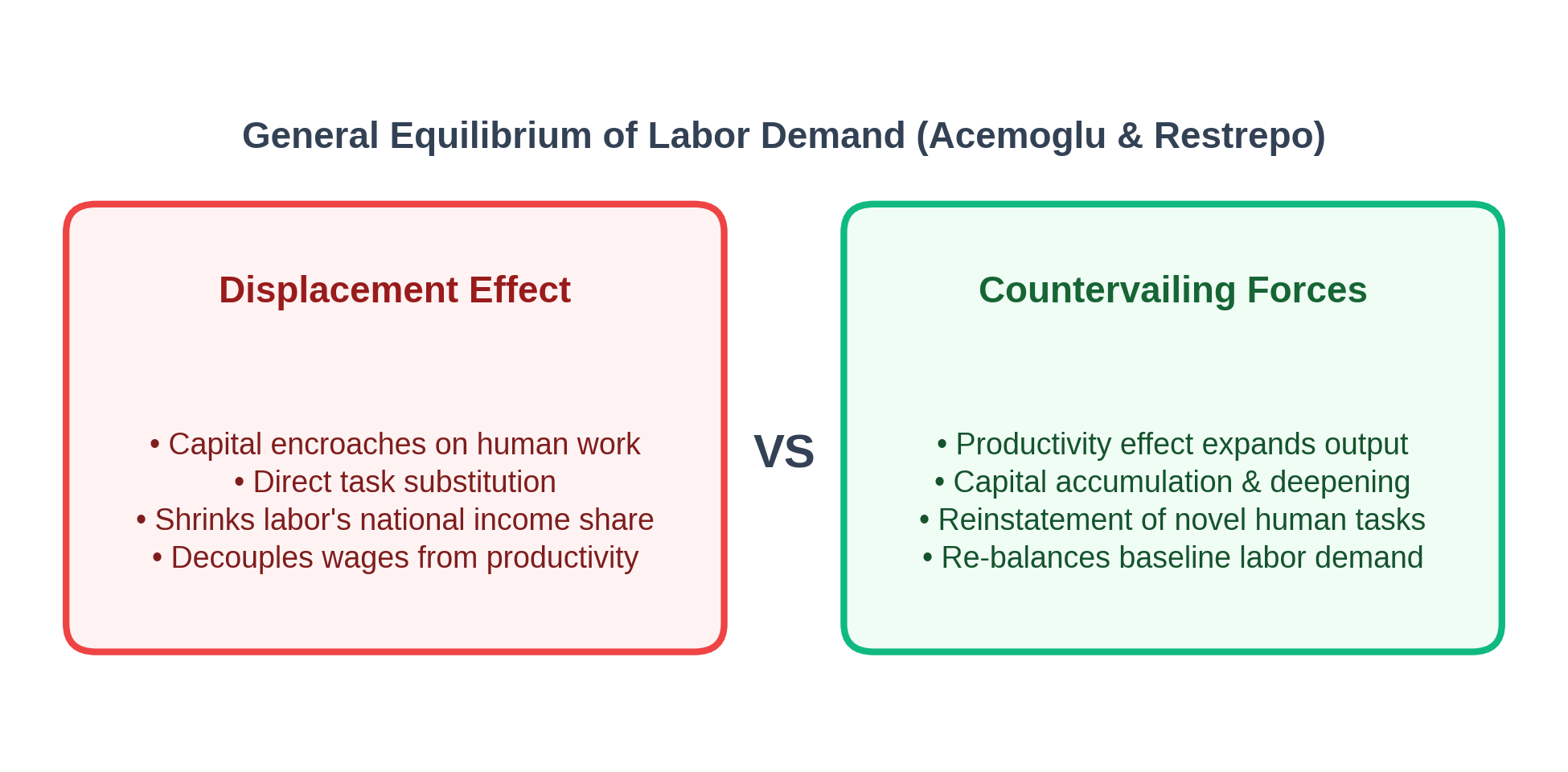
Daron Acemoglu and Pascual Restrepo developed a broader task-based displacement framework. Their research argues that when machines become capable of performing more tasks, companies may require fewer workers for those activities. This creates what they call the displacement effect. This lowers wages (especially for routine or mid-skill work), employment in affected areas, and labor’s overall share of national income. For example, if AI automates document review, fewer junior legal associates may be needed; if AI writes basic code, fewer entry-level programmers may be hired; and if AI handles customer queries, fewer support staff may be required.
However, Acemoglu and Restrepo also identify countervailing forces, forces that offset job losses. Countervailing forces include productivity growth, the creation of entirely new industries, the emergence of new tasks for humans, and growth in complementary jobs. For example, the rise of the internet eliminated certain jobs but created others, such as app developers, digital marketers, data analysts, cybersecurity professionals, social media managers, and many other such jobs. Their data shows automation caused 50–70% of changes in U.S. wage inequality from 1980 to 2016. For current AI, they estimate it affects roughly 19–23% of tasks, leading to relatively modest overall productivity gains (around 0.55% per year over a decade) because many complex tasks involving judgment and context remain difficult.
Macroeconomic Critiques: The Tabarrok Perspective
Maxwell Tabarrok and related model critics challenge these conservative estimates. Tabarrok argues that baseline task-based frameworks omit or undervalue capital deepening, new task creation, and competition-driven productivity channels. Assumptions about limited task impact and no significant capital deepening lead to understated TFP and GDP effects. AI’s scalability and deep workflow integration imply much larger structural reorganization and labor demand shifts. Historical and emerging evidence (such as robot adoption studies showing net employment gains) suggests that displacement is offset far more robustly through aggregate market responses than static projections allow.
4. Empirical Evidence and Work Augmentation
Danielle Li’s important field study with Erik Brynjolfsson and Lindsey Raymond, published in the Quarterly Journal of Economics, 2025 provides real-world evidence. In a major customer support center, introducing generative AI increased productivity by 14–15% on average (issues resolved per hour). However, the gains were dramatically higher for novices and lower-skilled workers (around 34%). The AI helped new employees learn faster by sharing best practices from top performers, effectively compressing the skill gap. Experienced workers gained little. This shows AI often augments beginners more than veterans.
Traditionally, expertise required years of experience and mentorship. AI may now shorten learning curves significantly by helping average performers work closer to expert levels. This could have major implications for education and skill development, serving as one reason why some researchers believe AI could democratize expertise rather than merely concentrate it.
Augmentation means AI enhances human capability rather than replacing it entirely. Researchers Thomas Davenport and Steven Miller studied numerous real-world AI deployments and found that most organizations still rely heavily on humans for judgment, contextual understanding, handling unusual situations, relationship management, and ethical decisions. A useful example is medicine. AI may help analyze scans or identify patterns in data, but doctors are still needed to speak with patients and understand emotional and family contexts. They are better suited to handle uncertainty and make ethical judgments. Similarly, in law, finance, education, consulting, and management, AI may increasingly function as a highly capable assistant rather than a total replacement.
Empirical Case Studies of Human-AI Collaboration
| Industrial Sector / Domain | AI Task Allocation Profile | Human Core Contribution Profile |
|---|---|---|
| Life Insurance Underwriting | Real-time lookup, routine application analysis, data summaries. | Complex judgment, final sign-off on unmodeled, high-risk cases. |
| Telemedicine & Clinical Care | Initial screening, basic triage chat, automated history retrieval. | Definitive diagnosis, empathetic patient care, ethical decisions. |
| Predictive Rail Maintenance | Algorithmic parsing of engine sensor feeds to flag anomalies. | Contextual interpretation of exceptions, physical execution of repair. |
| Food Service & Robotics | Standardized, automated frying and repetition execution. | Managing custom orders, responding to fluid environment variance. |
5. Displacement Risks vs. Augmentation Potential
Daron Acemoglu and Paul Krugman highlight serious risks under today’s dominant business approaches. Current AI development leans heavily toward automation, leading to task encroachment, reduced hiring for entry-level roles, layoffs explicitly linked to AI, wage pressure, and a declining labor share of income. Krugman points to significant labor market churn (frequent job changes), capital bias (gains flowing more to owners than workers), and reduced demand in roles like translation.
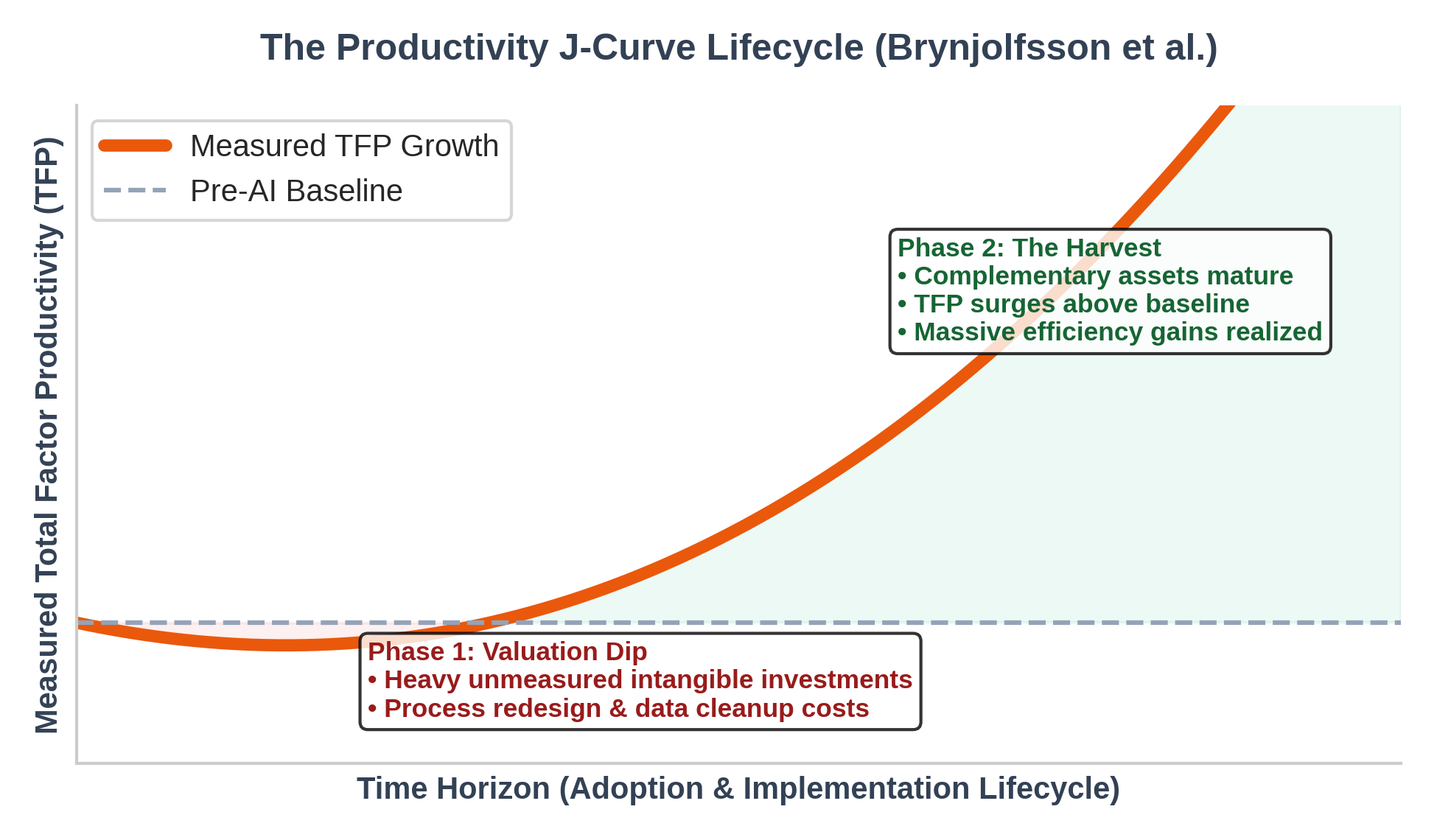
Erik Brynjolfsson, Danielle Li, and Thomas Davenport with Steven Miller show that in actual company deployments, augmentation (humans + AI working together) is more common than full replacement. Brynjolfsson describes the productivity J-curve. Just as with previous major technologies, initial measured productivity growth is slow because companies must invest heavily in retraining, new processes, and organizational changes. These upfront “intangible” investments create a temporary dip or lag (the bottom of the J) before productivity accelerates later once the new systems are working smoothly.
Electricity existed for decades before factories were redesigned to fully utilize it. Similarly, computers existed long before businesses reorganized themselves around digital workflows. AI may currently be in this transitional stage. Organizations still need to retrain workers, redesign workflows, and create appropriate governance systems. They still need to build trust and integrate AI into operations, which takes its own time.
6. The Historical Perspective and Innovation Economics
The economist Joseph Schumpeter described capitalism as a process of creative destruction. This means innovation simultaneously destroys old industries and jobs and creates new industries and opportunities. History repeatedly demonstrates this process. The automobile industry reduced horse-carriage industries but created automobile manufacturing and highways, and gave rise to new industries like tourism and logistics. Computers reduced some clerical jobs but created entirely new digital industries. AI appears likely to continue this historical pattern. However, transitions are rarely smooth. There are always periods of disruption, inequality, and uncertainty before societies adapt.
Philippe Aghion and Peter Howitt formalized this mathematically and showed an inverted-U relationship with competition. They said that moderate competition (not too little, not too much) often maximizes innovation. They also introduced neck-and-neck dynamics: when similar firms are close in technology, competition strongly motivates them to innovate to pull ahead (“escape competition”).
Joel Mokyr’s useful knowledge framework adds long-term optimism. Economic progress comes from combining theoretical understanding (why things work — propositional knowledge) with practical techniques (how to do things — prescriptive knowledge). AI can dramatically speed up this feedback loop, leading to new tasks and inventions that are hard to predict today. Labor shortages caused by aging populations may become a bigger issue than unemployment. Historically, executing high-value prescriptive knowledge required decades of deep cognitive apprenticeship to master the underlying propositional knowledge. AI completely breaks this link by decoupling execution from deep personal comprehension. It absorbs massive propositional knowledge repositories to instantly deliver actionable prescriptive knowledge outputs directly to the user.

7. Solutions and Institutional Levers
One of the strongest conclusions across the research is that technology alone does not determine outcomes. The research consensus is that outcomes are path dependent. They depend heavily on human choices. The future depends on questions such as: will companies use AI mainly to reduce costs or to empower workers, or will educational systems adapt?
Joel Mokyr argues that societies prosper when they maintain openness to new ideas and continuous learning. But history also shows that societies can become rigid, bureaucratic, and resistant to change. This means the AI transition is not only a technological challenge. It is also a social, educational, and institutional challenge.
We would need new types of universities focused on task augmentation (practical AI collaboration), creative destruction and innovation, and deep useful knowledge. We might have to shift to flexicurity as an employer-employee ecosystem. Flexicurity is a labor market model (pioneered in Denmark) that combines high flexibility for companies (easy hiring and firing to adapt to new technology) with strong security for workers (generous unemployment benefits and extensive retraining programs). It protects people, not specific jobs, making it easier for workers to move into new roles as tasks change. Above all, we would require a sustained openness to knowledge sharing to avoid Cardwell’s Law, which speaks about the historical tendency for societies to lose technological creativity after a period of success.
8. What is to be Seen
We are still in the early stages of AI’s impact. Task reconfiguration is already visible in workplaces. Productivity gains are real at the individual and team level but have not yet shown up strongly in national statistics due to the J-curve. Displacement risks are material, especially for routine and entry-level cognitive work. Augmentation and knowledge scaling offer powerful counterbalances, particularly for newer workers. Polarization, inequality, and verification challenges are unfolding, but new tasks, hybrid roles, and institutional adaptation can shift the trajectory.
9. Conclusion
The evidence rejects both extreme pessimism (mass unemployment) and naive optimism (effortless prosperity). Instead, it reveals a complex transition defined by task reconfiguration, creative destruction, and institutional choices. AI accelerates both destruction (of old tasks and routines) and creation (of new roles, scaled expertise, and paradigms).
The decisive factor is not what the technology will do, but what societies, companies, and individuals choose to do with it. By building the right education systems, adopting flexicurity-style policies, maintaining healthy competition, and sustaining openness to new knowledge, we can tilt the balance toward shared prosperity. History shows that adaptation is possible when conditions are deliberately aligned. The current wave of AI is our generation’s test. The research gives us a clear map. The responsibility and the opportunity are ours to act.
References
Acemoglu, D. (2024). “The Simple Macroeconomics of AI.” National Bureau of Economic Research (NBER) Working Paper No. 32487.
Acemoglu, D., & Johnson, S. (2023). Power and Progress: Our Thousand-Year Struggle Over Technology and Prosperity. PublicAffairs.
Acemoglu, D., & Restrepo, P. (2018). “Artificial Intelligence, Automation and Work.” National Bureau of Economic Research (NBER) Working Paper No. 24196.
Acemoglu, D., & Restrepo, P. (2019). “Automation and New Tasks: How Technology Displaces and Reinstates Labor.” Journal of Economic Perspectives, 33(2), 3–30.
Aghion, P., Bloom, N., Blundell, R., Griffith, R., & Howitt, P. (2005). “Competition and Innovation: An Inverted-U Relationship.” Quarterly Journal of Economics, 120(2), 701–728.
Aghion, P., & Howitt, P. (1992). “A Model of Growth Through Creative Destruction.” Econometrica, 60(2), 323–351.
Autor, D. H., & Dorn, D. (2013). “The Growth of Low-Skill Service Jobs and the Polarization of the U.S. Labor Market.” American Economic Review, 103(5), 1553–1597.
Autor, D. H., Levy, F., & Murnane, R. J. (2003). “The Skill Content of Recent Technological Change: An Empirical Exploration.” Quarterly Journal of Economics, 118(4), 1279–1333.
Brynjolfsson, E., Li, D., & Raymond, L. (2025). “Generative AI at Work.” Quarterly Journal of Economics, 140(1).
Brynjolfsson, E., Rock, D., & Syverson, C. (2021). “Artificial Intelligence and the Modern Productivity Paradox: A Clash of Expectations and Statistics.” Building Resilient Economies, NBER.
Davenport, T. H., & Miller, S. M. (2022). Working with AI: Real Stories of Human-Machine Collaboration. MIT Press.
McElheran, K., Li, D., Brynjolfsson, E., et al. (2025). “AI Adoption and Firm-Level Productivity: Evidence from US Census Data.” Census Bureau Working Paper.
Mokyr, J. (2002). The Gifts of Athena: Historical Origins of the Knowledge Economy. Princeton University Press.
Mokyr, J. (2016). A Culture of Growth: The Origins of the Modern Economy. Princeton University Press.
Tabarrok, M. (2024). “Productivity Deepening and Aggregate Elasticities: A Response to the Cautious Macroeconomics of AI.” Economic Inquiry Perspectives.
Tufekci, Z. (2025). “The Verification Crisis: How Generative Outputs Break Institutional Gatekeeping and Selection Mechanisms.” Panel on AI and the Future of Work, CUNY.
