
.png)
.png)

Bounded Rationality, Satisficing, and Organizational Velocity
| Modern decision-making is frequently treated as an optimization problem to be solved perfectly. However, the relentless pursuit of the absolute best exhausts critical cognitive bandwidth. The antidote is satisficing: establishing clear, pragmatic baseline criteria and stopping as soon as an option meets them. This shift from absolute maximization to dynamic optimization accelerates operational velocity and preserves human capital. |
1. Bounded Rationality & The Satisficing Heuristic
Classic economic theory relies on the myth of Homo economicus, the perfectly rational actor who weighs every variable, calculates every outcome, and unerringly chooses the absolute optimal path. In the mid-20th century, Herbert Simon, a towering polymath who won the Nobel Prize in Economics, the Turing Award in computer science, and the APA Distinguished Scientific Contribution Award in psychology, dismantled this model with his theory of bounded rationality.
Simon demonstrated that human beings cannot make perfectly optimal choices due to three fundamental constraints:
- We possess finite computational brainpower.
- We operate with imperfect, fragmented, and incomplete information.
- We are strictly limited by time.
In his landmark 1955 paper, Simon argued that we must replace ideal “global rationality” with behavioral strategies compatible with the actual capacities of organisms in real-world environments. Out of this framework came “satisficing,” a portmanteau of satisfy and suffice. Rather than chasing an unattainable optimum, decision-makers establish an aspiration baseline (a “good enough” threshold) and stop searching the moment it is achieved. This is not laziness or settling for mediocrity; it is a highly rational, efficient, and mathematically sound adaptation to a complex world.
2. The Psychological Toll of Maximizing
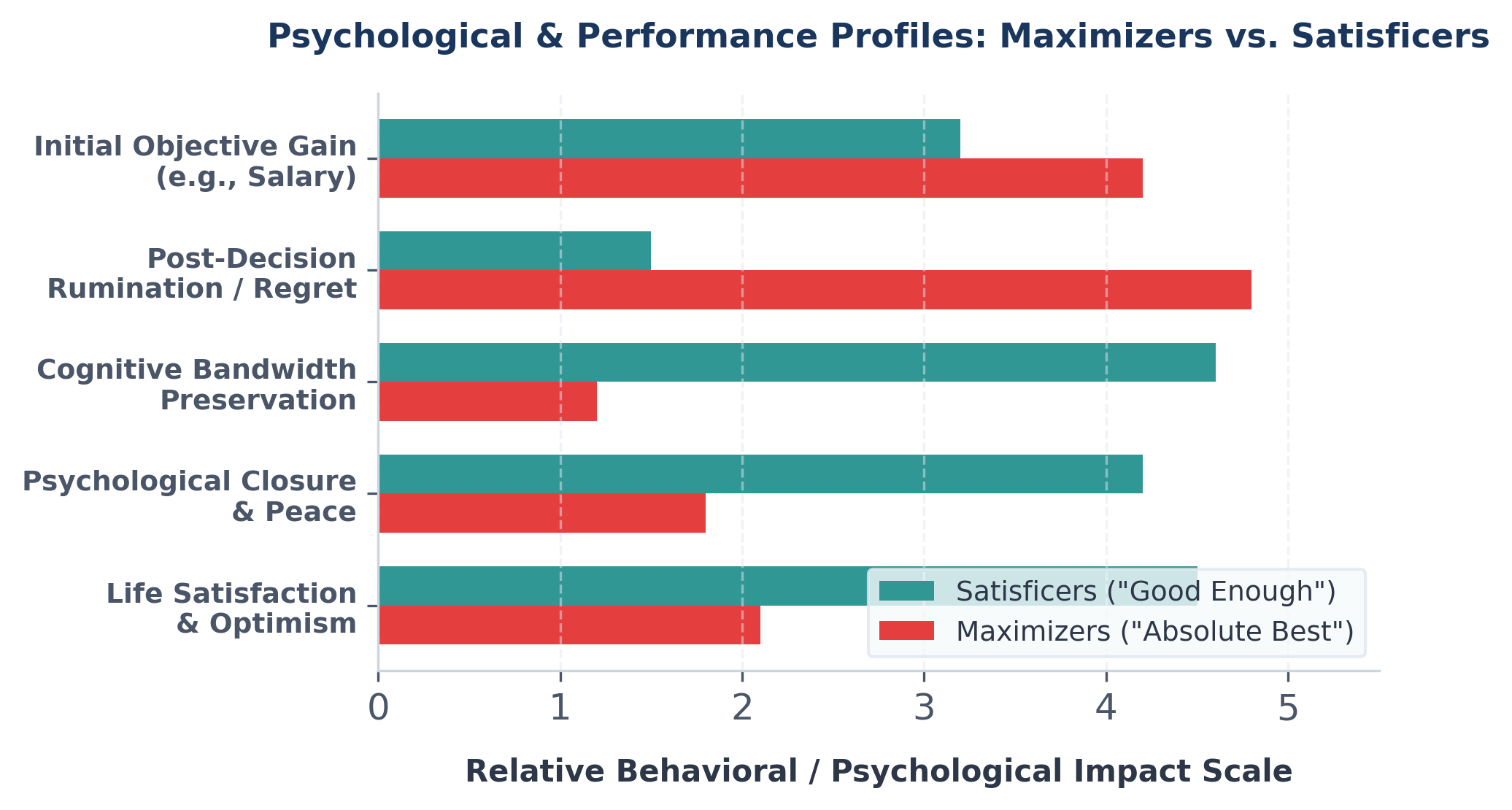
Subsequent behavioral research has validated Simon’s models. Psychologist Barry Schwartz, author of The Paradox of Choice, demonstrated that “maximizers” (those who exhaustively evaluate every single alternative) experience significantly worse psychological outcomes than “satisficers.” Across multiple cohorts, maximizers reported higher rates of regret, depression, perfectionism, and social comparison, coupled with lower levels of life satisfaction, optimism, and self-esteem.
They remain mired in post-decision rumination, remaining unhappy even when achieving objectively superior outcomes.
The abundance of choices in modern technology and markets induces choice paralysis, inflates opportunity costs, and inhibits commitment. Reversibility worsens this dynamic; leaving options open prevents psychological closure, triggering a baseline state of anxiety. For example, studies reveal that while maximizers often secure higher initial starting salaries out of university, they report lower overall job satisfaction and higher negative affect throughout the job search process.
Furthermore, Roy Baumeister’s seminal research on ego depletion establishes that conscious decision-making draws from a highly finite mental resource. Exhausting this neural currency on trivial choices (such as endless product option comparisons) severely depletes an individual’s capacity for complex, high-stakes creative or strategic thinking.
3. Herbert Simon’s Cognitive Budgeting
Observing Herbert Simon’s daily routines without context might lead one to mistake him for an individual entirely devoid of ambition. He ate the exact same breakfast every morning, lived in the same house for 46 years, and famously asserted that an individual requires only three sets of clothing: one to wear, one in the closet, and one in the wash.
Yet, this was the thinker who laid the foundation for artificial intelligence, organizational behavior, and cognitive psychology. Simon understood that human willpower and analytical precision draw from the same energy reservoir. By ruthlessly satisficing his mundane daily selections—food, shelter, and wardrobe—he preserved his scarce cognitive bandwidth for deep, legacy-defining problems.
4. Building Agile Organizations: The Amazonian Framework
Enterprises frequently fall into the maximizer trap, treating every minor operational selection as a make-or-break crisis requiring exhaustive analysis. This behavior fosters bureaucracy, drives crippling project delays, and accelerates talent burnout.
In his famous 1997 letter to shareholders, Jeff Bezos engineered an operational framework to combat this: the division of choices into Type 1 and Type 2 decisions. This system serves as a real-world execution of Simon’s bounded rationality, keeping organizational maximizers from squandering bandwidth where satisficing is required.
Amazon categorizes strategic choices into two buckets based on risk, velocity, and reversibility:
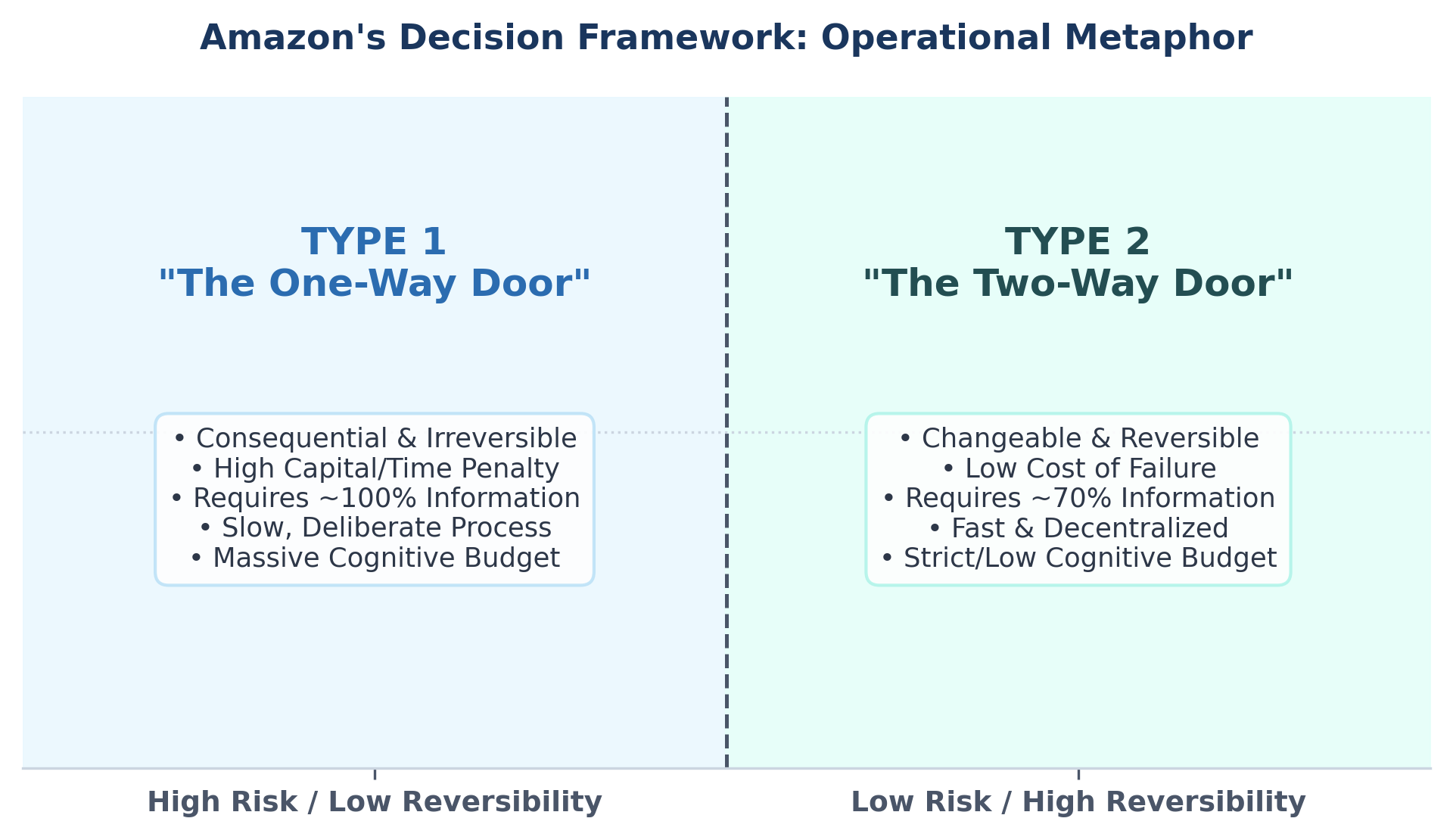
Type 1: The One-Way Door
These decisions are highly consequential and practically irreversible. Walking through this door incurs a massive penalty in capital, time, or market reputation if the outcome is poor. Type 1 choices require deep deliberation, extensive cross-functional consultation, and slow, deliberate processing.
Type 2: The Two-Way Door
These decisions are fluid, changeable, and easily reversible. If a Type 2 decision yields a suboptimal result, the organization can simply step back through the door, shut it, and try another path. The cost of failure is negligible. Consequently, these choices must be decentralized and executed rapidly by small teams or capable individuals.
Information Thresholds and Cognitive Budgeting
Maximizers waste significant corporate energy attempting to collect 100% of available data before executing. Bezos explicitly countered this behavior, establishing that most decisions should be made with roughly 70% of the desired information.
Classifying a choice as a Type 2 decision forces a strict operational limit: it signals the team to halt data ingestion, accept the 70% threshold, and satisfice. Chasing the final 30% of data for a reversible option is an expensive waste of cognitive capital.
Because corporate cognitive bandwidth is a finite resource, leaders must allocate it symmetrically. Type 1 decisions receive an expansive cognitive budget, permitting thorough data mapping. Type 2 decisions are kept on a lean budget and pushed to edge teams, keeping executive bandwidth completely clear.
| Dimension | Type 1: One-Way Door | Type 2: Two-Way Door |
|---|---|---|
| Reversibility | Nearly irreversible; high exit and correction penalties. | Highly reversible; easy to undo, pivot, and re-test. |
| Information Target | Exhaustive data collection and validation (~100% data target). | Actionable operational thresholds (70% data target). |
| Velocity & Speed | Slow, cautious, multi-layered oversight and consensus. | Rapid, autonomous, decentralized edge execution. |
| Cognitive Budget | Massive allocation; complete multi-angle assessment. | Strictly rationed; localized to protect executive focus. |
| Strategic Focus | Satisfies global criteria for high-stakes pivots. | Embraces “good enough” parameters to maximize operational speed. |
5. Strategic Baselines for Modern Leadership
Satisficing is not a concession to anti-ambition; it is a highly disciplined framework for resource allocation in an era designed to fragment institutional attention. By pre-defining clear parameters for what constitutes a “good enough” outcome for routine execution, modern leaders safeguard their organizations’ premium asset: unfragmented focus.
Adopting a satisficing stance recognizes an essential truth: while a maximizer might occasionally yield a marginal objective victory in an isolated scenario, the cumulative systemic drag measured in decision fatigue, burnout, and operational delay is prohibitively expensive.
In highly volatile, fast-moving markets, the velocity and psychological agility unlocked via satisficing reliably outpace the sluggish drag of over-optimization.
Ultimately, Simon’s work champions a healthier, more authentic approach to organizational performance. It untethers teams from the exhausting cycle of endless optimization, building sustainable spaces for genuine execution, speed, and real brilliance where it matters most. In a hyper-connected environment, knowing when to choose “good enough” is not an operational compromise—it is leadership wisdom.
References
- Baumeister, R. F., Bratslavsky, E., Muraven, M., & Tice, D. M. (1998). Ego depletion: Is the active self a limited resource? Journal of Personality and Social Psychology, 74(5), 1252–1265.
- Bezos, J. P. (1997). Letter to Amazon.com Shareholders. Amazon Annual Report.
- Schwartz, B. (2004). The Paradox of Choice: Why More Is Less. New York: Ecco.
- Simon, H. A. (1955). A Behavioral Model of Rational Choice. The Quarterly Journal of Economics, 69(1), 99–118.
- Simon, H. A. (1956). Rational Choice and the Structure of the Environment. Psychological Review, 63(2), 129–138.
